
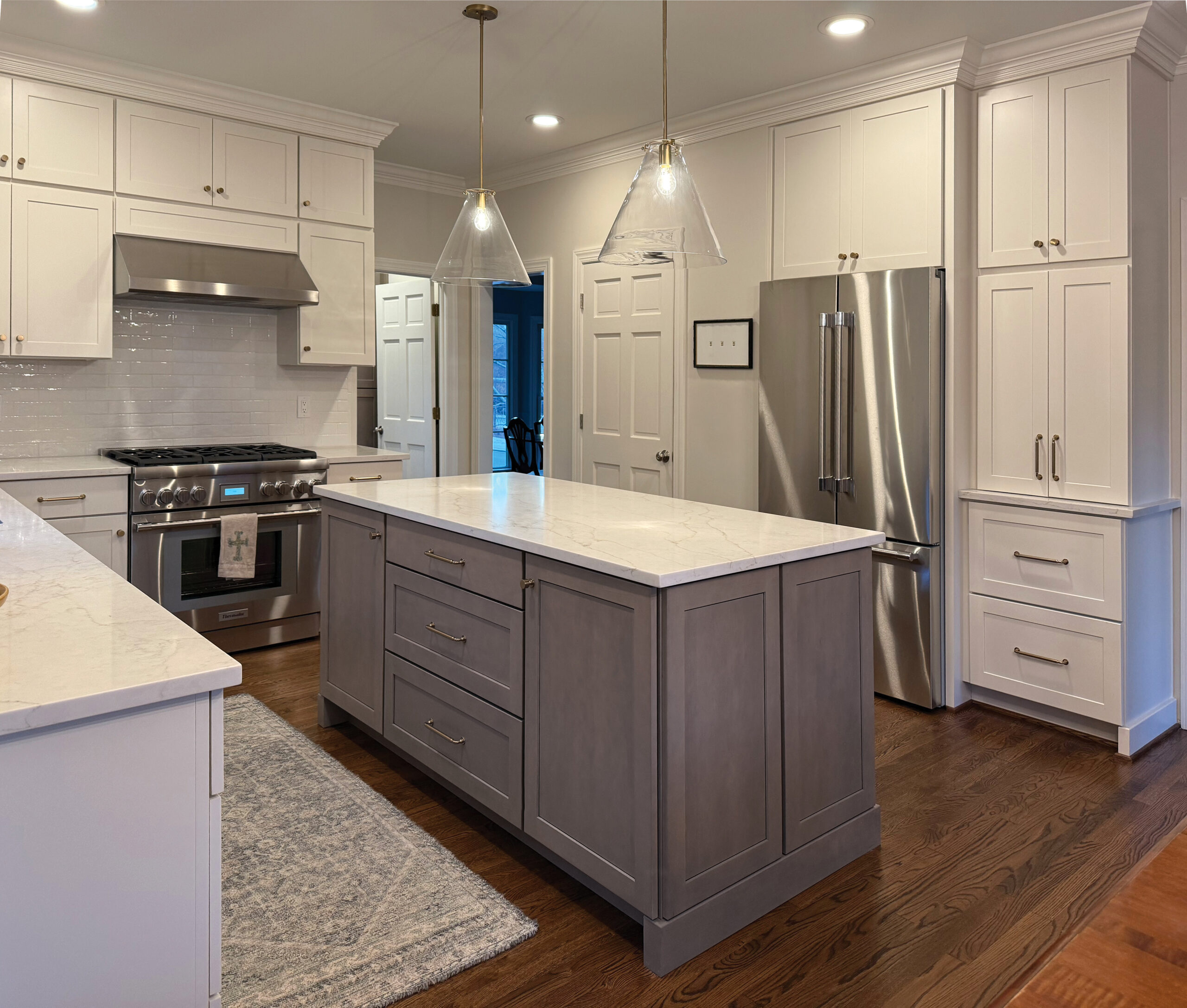
Cabinets are the backbone of your kitchen. They set the style, hold almost everything you own in that room, and typically take the largest share of a kitchen remodel budget. They’re also something you’ll live with for 20 years or more. In the post, we will discuss 10 things to consider when choosing kitchen cabinets.
Most homeowners choose cabinets by looking at a door sample and a price. What’s behind the door — the box, the joinery, the hinges, the finish — is what decides whether your kitchen still looks and works great a decade from now.
This guide walks you through the 10 most important things to consider when choosing cabinetry, so you can ask the right questions and invest with confidence.
1. Set a Realistic Budget — and Think in Terms of Value
Start with a number, but don’t let the lowest quote win by default. Cabinets often account for roughly a third of a full kitchen remodel, so they deserve a clear slice of your budget from the start.
The better question is cost per year of use. A cabinet that stays square, opens smoothly and holds its finish for 25 years is cheaper over time than one you’re replacing or repairing in eight.

Ask yourself:
- How long do I plan to stay in this home?
- Am I renovating for my own use or for resale?
- Which upgrades matter most to me — finish, storage features or hardware?
2. Understand Cabinet Construction: Framed vs. Frameless
Every cabinet is built one of two ways, and the choice affects both look and storage. Learn more about framed and frameless cabinetry from prior Bishop posts.
| Framed (face-frame) | Frameless (full-access) | |
| How it’s built | A solid-wood frame is attached to the front of the box | No front frame; doors mount directly to the box sides |
| Look | Traditional, transitional, farmhouse | Clean, modern, European |
| Door options | Full overlay or inset | Full overlay |
| Storage | Frame slightly narrows openings | Wider openings, easier access |
| Strength | Frame adds rigidity | Relies on a thick, well-built box |
Neither is “better” — but each needs to be built well. Look for glued and fastened joints (dowels, dados or rabbets), not just staples.
3. Check the Box Material: Plywood, Particleboard or MDF
The cabinet box (or “carcass”) does the structural work. It’s the part you don’t see — and where many budget lines cut corners.
| Material | Strengths | Watch-outs | Best for |
| Furniture-grade plywood | Strong, holds screws well, more moisture-tolerant | Higher cost | Sink bases, wall cabinets, long-term value |
| MDF | Very smooth and stable, paints beautifully | Heavy; swells if water gets in | Painted doors and panels |
| Particleboard | Low cost, flat and stable | Weakest screw-holding; swells badly when wet | Budget projects in dry areas |
Tip: Ask about box side thickness (1/2″ vs. 3/4″) and the back panel. A full-thickness back adds rigidity and gives installers something solid to anchor into.
4. Choose a Door Style That Fits Your Home — and Your Habits
Doors are what everyone sees, so they drive the style of the whole room.
- Shaker: A simple recessed panel. Timeless, versatile and the most popular choice for good reason.
- Slab (flat-panel): Minimal and modern. Easy to clean, with no edges to collect dust.
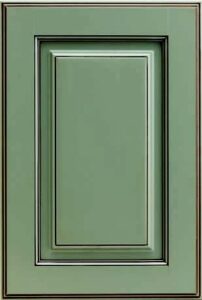
- Raised panel: More traditional and formal, with a contoured center panel.
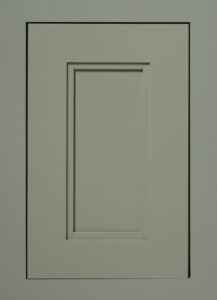
- Inset: Doors sit flush inside the frame. A premium, furniture-like look that requires precise craftsmanship.
- Glass-front: Great for displaying dishware and lightening up a run of wall cabinets.
Think about upkeep, too. Detailed profiles look rich but take more effort to clean. If you cook a lot, a simpler door may suit you better.
Shaker
Slab
Raised Panel
Inset

5. Pick the Right Wood Species and Finish
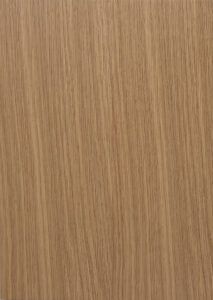
The species and finish determine color, grain and how well your cabinets stand up to daily life.
Common species:
- Maple: Smooth, tight grain. Excellent for paint or a clean stained look.
- Oak (red or white): Strong, visible grain. White oak is especially popular for natural finishes.
- Cherry: Rich and warm; darkens beautifully with age.
- Hickory: Very hard, with bold color variation for a rustic feel.
- Birch: Strong, visible grain. Economical.
- MDF: Very popular for paint. Smooth surface. Little to no warping.
Finish matters as much as the wood. Ask what the finish is and how it’s applied. A multi-step, factory-applied, catalyzed finish resists moisture, grease and cleaners far better than a single brushed coat.
Painted cabinets look crisp, but all painted wood can show hairline cracks at joints as it expands and contracts with the seasons. Also, wood can warp in the dry winter months but then return to its original form in the spring. Those changes are normal — just know to expect it.
6. Don’t Overlook the Hardware: Hinges, Slides and Drawer Boxes
You’ll open your cabinets thousands of times a year. The moving parts decide how your kitchen feels every single day.
- Hinges: Look for concealed, adjustable hinges with soft-close. Adjustability lets doors be re-aligned over time.
- Drawer slides: Full-extension, undermount soft-close slides let you reach the back of the drawer and close quietly. Check the weight rating — heavy pots need sturdy slides.
- Drawer boxes: Solid wood with dovetail joints is the gold standard. Stapled particleboard drawers are a red flag.
Quick showroom test: Pull a drawer all the way out and push down on it. It should feel solid, not wobbly.
7. Plan the Layout and Storage Around How You Live
Beautiful cabinets that don’t fit your routine will frustrate you daily. Before choosing finishes, think about how you actually use the kitchen.
- Drawers over doors in base cabinets: Deep drawers make pots and pans far easier to reach than shelves behind doors.
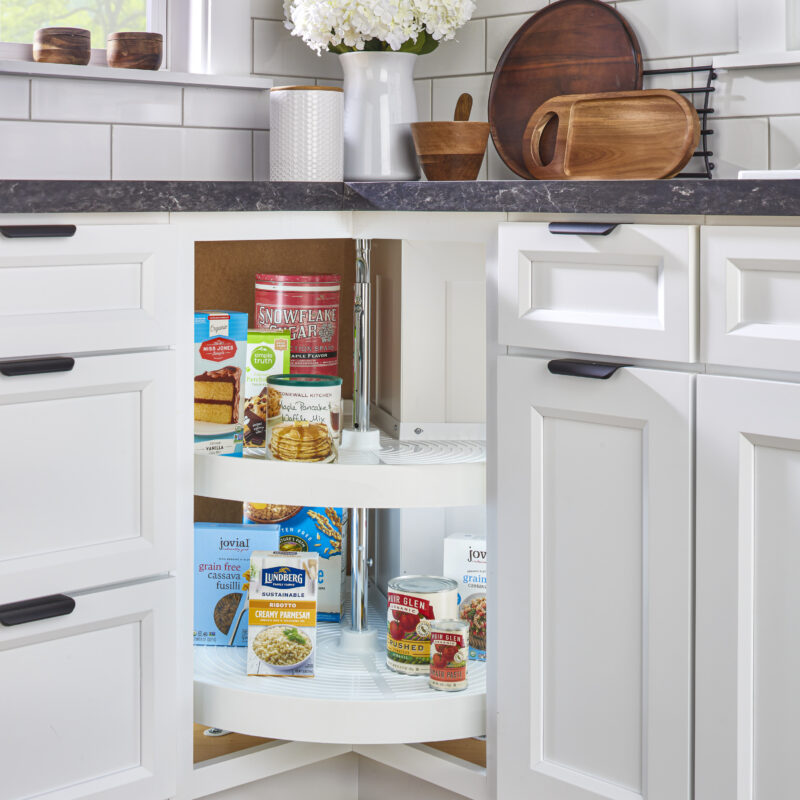
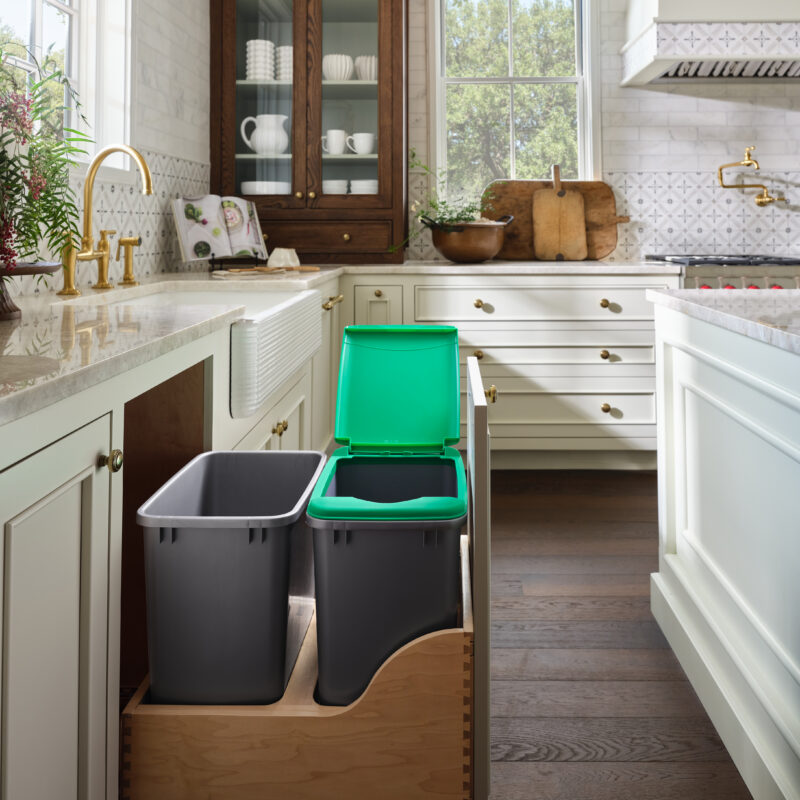
- Specialty storage: Pull-out trash and recycling, spice pull-outs, tray dividers, corner solutions and roll-out shelves.
- Wall cabinet height: Taller uppers or stacked cabinets to the ceiling add storage and eliminate dust-catching tops.
- Work zones: Keep prep, cooking and cleanup items near where you use them.
- Accessibility: Plan for aging in place with easy-reach storage, pull-down shelves and appropriate counter heights.
A good designer will ask about your habits before showing you samples. Rev-A-Shelf offers numerous storage and organization accessories. Here are the most popular cabinet accessories at Bishop Cabinets.
Lazy Suzanne
Trashcan Pullout
8. Decide Between Stock, Semi-Custom and Custom Cabinets
This choice shapes your price, lead time and how well the cabinets fit your space.
| Type | Sizing | Design options | Lead time | Best for |
| Stock | Fixed sizes, usually in 3″ increments | Limited | Fastest | Rentals, quick updates, tight budgets |
| Semi-custom | Standard sizes with some modifications | Moderate | Moderate | Most mid-range remodels |
| Custom | Built to your exact measurements | Nearly unlimited | Longest | Unusual spaces, high-end homes, long-term value |
With stock cabinets, gaps are often hidden with filler strips. Custom cabinetry uses every inch, which can mean more storage — and a more built-in, finished look.
9. Plan for Professional Installation
Even the best cabinets will look and perform poorly if they’re installed badly. Walls and floors are rarely perfectly flat or square, and a skilled installer compensates for that.
Good installation means:
- Cabinets are level, plumb and securely anchored into studs.
- Doors and drawers are adjusted so gaps (“reveals”) are even.
- Scribe molding and fillers are fitted cleanly to walls and ceilings.
- Countertop templating is coordinated with the cabinet install.
Having one team responsible from design through install means fewer handoffs and fewer finger-pointing problems.
10. Look at the Warranty and the Manufacturer’s Reputation
A warranty tells you how much confidence a manufacturer has in its own work. Read it closely.
- What’s covered: Boxes, doors, finish and hardware may each carry different terms.
- How long: Compare years of coverage, and whether it’s “limited lifetime” and what that excludes.
- Who handles service: Will the dealer send someone, or are you on your own?
Then look past the paperwork:
- Read reviews and ask for references from recent customers.
- Visit a showroom — or better, ask to see the shop.
- Ask how they check quality before cabinets ship.
A manufacturer that’s proud of its process will be happy to show it to you.
Frequently Asked Questions About Choosing Cabinets
What is the most durable material for kitchen cabinets? Furniture-grade plywood boxes with solid-wood doors and a factory-applied catalyzed finish offer excellent long-term durability, especially around sinks and dishwashers.
Are custom cabinets worth the cost? If you plan to stay in your home for years or have an unusual layout, custom cabinets often deliver better fit, more storage and longer life — making them a strong value over time.
How long do custom cabinets take? Lead times vary by manufacturer and season. Custom cabinetry generally takes longer than stock, so ask for a realistic timeline early and plan your remodel around it.
Should I choose painted or stained cabinets? Painted cabinets offer a clean, bright look. Stained cabinets show off wood grain and tend to hide minor wear. Both last well with a quality factory finish.
What’s the difference between framed and frameless cabinets? Framed cabinets have a solid-wood face frame for a traditional look. Frameless cabinets skip the frame for a modern look and slightly more interior space.
ABOUT BISHOP CABINETS
For more than 60 years, Bishop Cabinets has proudly manufactured quality cabinetry that combines craftsmanship, durability, and innovation. From timeless styles to today’s most popular finishes and storage solutions, we’re committed to helping homeowners create beautiful, functional spaces that stand the test of time.
Learn more about Bishop Cabinets, our products, and our latest innovations.
Our Vision
“To create beautiful and functional cabinets through innovation, growth, and a commitment to keep family values at the core of everything we do.”